
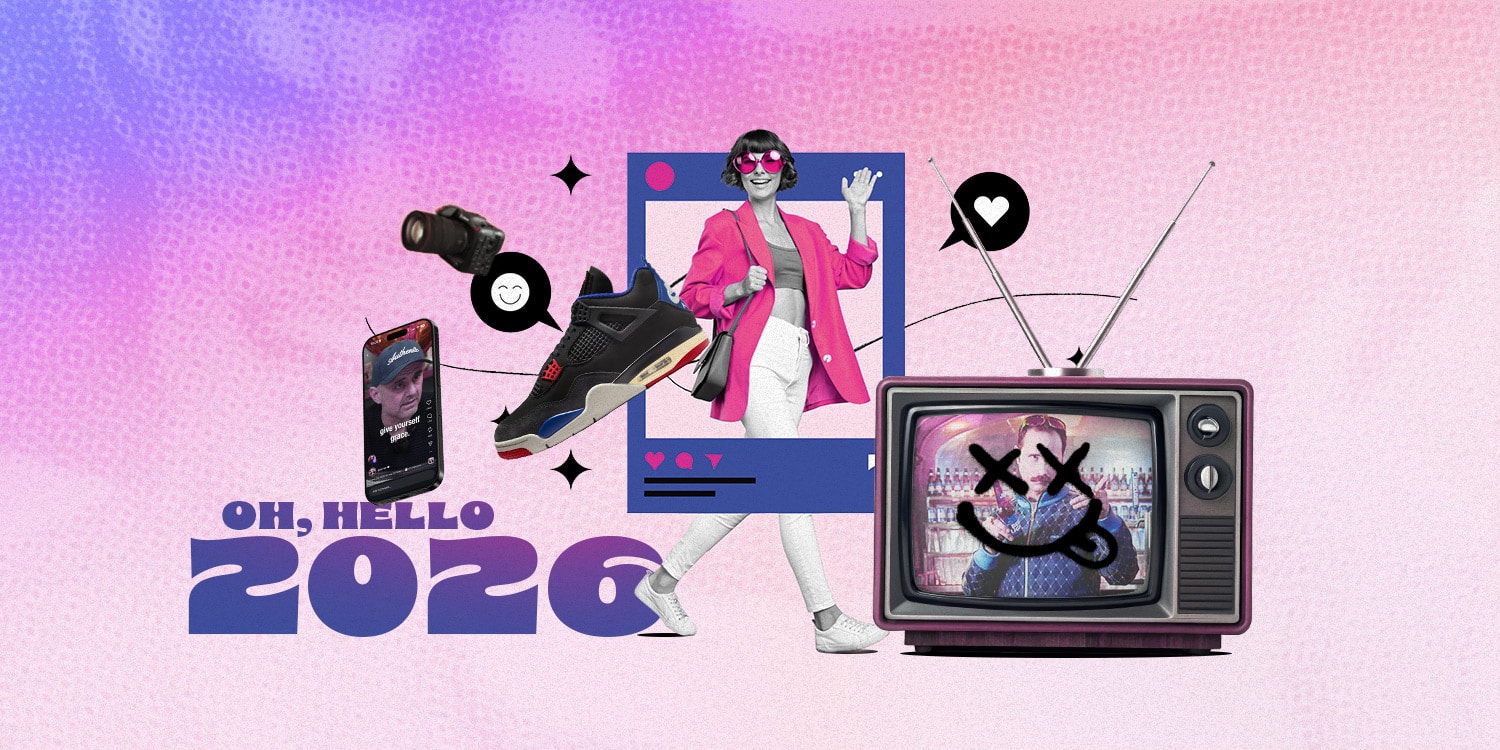
It’s that time of year again. It’s pitch dark before I sit down for dinner, half of my body weight is comprised of baked goods, and now, I join the array of marketers offering you hot takes and bold predictions on what will define the industry in the new year.
None of this is an exact science, and if I could see into the future, I would at least put it behind a paywall. But through reviewing the many drastic changes marketing experienced in 2025, reading customer sentiments, and analyzing multiple data points, I’ve pinpointed five trends that marketers need to be aware of to enter 2026 a step ahead of the competition.
Authenticity, not AI, will win on social
Forgive me for sounding like every other “agency bro” you know, but David Ogilvy was ahead of his time. When Ogilvy famously said, “The consumer is not a moron. She is your wife,” he had no idea how true that statement would be in the age of AI. Even in an era of unlimited automation, audiences can still spot the difference between content created to speak to them and content created to sell to them.
As OpenAI’s Sora floods feeds with AI-generated videos and Meta rolls out AI-powered ad creative, consumers are looking for real faces, real stories, and real connection more than ever before. If you’re using AI to mass produce social content that’s nothing more than a digital billboard, your audience will burnout, engagement will wane, and yes, even sales will suffer. But if you use AI to scale and improve efficiency in the background while focusing your social efforts on authentic brand storytelling, the rewards will follow.
Community-driven marketing will secure customer retention
The differentiator in modern marketing isn’t volume; it’s finding a niche to belong to and providing value within it. Brands that invest in making their channels a space for audiences to connect with each other rather than just the brand will see deeper retention, strong advocacy, and more protection against the ever-evolving algorithms.
Consider investing some of your marketing efforts and budget to be present on channels that are geared towards fostering community, such as Reddit, Twitch, trade publications, local blogs, and more. Today’s consumers aren’t just buying goods; they’re buying into the people, values, and experiences that surround them. I know it sounds counterintuitive, but the more your brand can be the facilitator of community rather than the center of attention, the better it will serve you in the long run.
”If you’re using AI to mass produce social content that’s nothing more than a digital billboard, your audience will burnout, engagement will wane, and yes, even sales will suffer. But if you use it to improve efficiency and focus efforts on authentic brand storytelling, the rewards will follow.
Ryan MainvilleSr. Social Media Manager
AI-focused SEO will lead to dominant organic search performance
Winning organic search is no longer about gaming the algorithm; it’s about alignment with the search habits of today’s consumer. With Google’s AI Overviews redefining the SERP experience and more users turning to AI models for everyday searches, brands need content that speaks like a human but is structured for machine.
Identifying intent patterns, analyzing audience behavior at scale, and building content ecosystems that anticipate what people will ask next is how you win now. Creating high-trust, high-utility content that both humans and search engines see as indispensable will serve your organic search performance much better in 2026 than stuffing keywords into H1s.
Traditional TV is set for a comeback
Getting tired of trying to reach the entirety of your audience in an age of peak fragmentation? You’re not alone. The solution very well could be a classic one: traditional TV.
Cord-cutting reshaped the landscape, and streaming stole the spotlight, but with subscription prices continuing to rise and fragmentation at a breaking point, advertising on traditional TV offers something hard to find today: consistency. The channel still offers the same guaranteed reach and shared experience as before, but with big advancements in addressable TV and cross-channel attribution, maybe traditional TV isn’t so traditional anymore. And maybe it can be the true anchor point for your brand’s storytelling and media mix in 2026.
Mid-sized influencers will slowly fade out of relevance
Finally, after years of inflated rates, diminishing returns, and seemingly random collaborations, the influencer landscape seems destined for a self-correction. Expect a majority of brands in 2026 to focus on partnering with two types of influencers: micro-creators, and high-impact marquee talent.
Mid-sized influencers try to play a middle ground, offering enough reach to move the needle but enough specificity for alignment. What that has really resulted in is audiences too large to feel personal but too small to command influence. Consumers are now looking for creators that feel like trusted friends or unmistakable talents. Whether you’re allocating spend for a community-driven creator or a big-bet collaboration, make sure you’re not stuck in a “safe middle ground” that’s no longer moving the needle.
Penned by our Sr. Social Media Manager, Ryan Mainville. He drinks a lot of espresso…like, a lot of espresso, loves basketball and a good story. And, apparently, partakes in baked goods quite often.