

By Point
At some point in nearly every land plan, someone pulls up the tree survey and starts counting lots. The oaks along the creek could become another row of homes, and most pro formas stop there.
That calculation captures what preservation costs. It doesn’t capture what the trees may be worth.
Buyers increasingly say they’ll accept a smaller yard to live in a walkable neighborhood near parks, shops, and other amenities. Meanwhile, residents regularly turn out at public hearings to defend the same trees developers plan to clear. Both factors can affect the financial performance of a project.
From a real estate development marketing perspective, the initial argument is simple: keep the trees, bring nature into the community, and turn the setting into a marketable difference.
But several of us at Point were bankers before we went into marketing, so we decided to give that advice the CFO and investor test. Can developers put a credible value on the nature factor and make the whole thing make cents?
We think they can.
Buyer Preferences Are Changing the Land-Plan Equation
The traditional calculation weighs the value of preserved land against the revenue from additional lots. That comparison still matters, but it leaves out what buyers may pay for the broader community around the home.
The National Association of REALTORS® surveyed 2,000 residents across the country’s 50 largest metropolitan areas for its 2026 Community and Transportation Preference Survey. When respondents chose between a larger lot that required more driving and a smaller lot in a walkable neighborhood, 59% selected the smaller, walkable option.
The same survey found that:
- 63% would pay more to live within walking distance of parks, shops, and restaurants.
- 82% consider easy walking access to shops and parks important when deciding where to live.
- 89% consider sidewalks and places to walk important.
- 63% view small-lot single-family homes favorably.
Those findings don’t mean every buyer wants less private space. They do suggest that lot size is only one component of perceived value. Some buyers will trade private acreage for access to trails, parks, tree cover, and a more connected daily experience.
NAHB has identified a similar preference. Its latest reporting found that 66% of buyers want to live near a park, 66% want access to walking or jogging trails, and 65% want a walkable community.
That changes the financial question. Instead of asking only how many lots can fit on the land, developers can also ask what combination of lots, natural features, and shared spaces creates the strongest market position.
Do Trees Increase Property Value?
Research suggests they can, although the effect varies considerably by market and location.
A study involving researchers from Virginia Tech and the U.S. Forest Service examined the relationship between tree cover and residential values across nine metropolitan markets. The findings showed that buyers didn’t value every tree in every location equally.
In Milwaukee, additional tree cover within roughly 330 feet was associated with an estimated $39,701 increase in home value. In Frisco, Texas, adding trees on or immediately around the property produced little additional value, while tree cover farther from the home was associated with a larger premium.
That distinction matters. A national percentage shouldn’t be pasted directly into a local pro forma. The value depends on the market, existing canopy, neighborhood context, and location of the trees relative to the home.
For a developer, the practical questions are more specific:
- Do wooded lots sell for more than comparable interior lots?
- Does proximity to a trail, creek, park, or preserved tree stand command a premium?
- Do those lots sell faster?
- Can preserved land increase the value of surrounding lots rather than only those directly adjacent to it?
- Does a recognizable natural feature strengthen the positioning of the entire community?
Local comps and prior-phase sales will provide better answers than a national average. The research establishes that the value can exist. The developer still needs to determine how much of it the project can capture.
The Cost of Opposition Belongs in the Model
Tree preservation also has value on the approval side of the project.
A national construction survey from the National Multifamily Housing Council and National Association of Home Builders found that dealing with neighborhood opposition added an average of 5.6% to total development costs and delayed completion by an average of 7.4 months.
That study addressed multifamily development and dates to 2022, so its averages shouldn’t be treated as a universal forecast. The underlying cost categories, however, are familiar across real estate development:
- Additional interest and land-carry costs
- Redesign and engineering expenses
- Added legal and consulting fees
- More public meetings and staff time
- Delayed construction and sales
- Reputational friction with neighbors and local officials
Tree removal continues to create that kind of friction in North Texas. In July 2026, the Fort Worth Urban Design Commission considered a request to reduce the tree-preservation requirement at a White Settlement Road site from 25% to 11.1%. The commission denied the request after neighborhood opposition and concerns about mature post oaks and incomplete site planning.
One denied waiver doesn’t establish the cost of opposition for every project. It does show why developers should treat public acceptance as more than a communications issue that begins after the plan is finished.
Preserving the natural feature residents already value may reduce opposition. At minimum, it gives the developer a stronger story to tell: what will remain, how it will be protected, and how the land will serve the surrounding community.
How to Calculate the Tree Math
The model begins with the visible cost, then adds the forms of value that a lot-count analysis may overlook.
- Calculate the Margin You Give Up
Start with the number of lots removed from the plan and the expected contribution margin from each.
Foregone lot margin = lots removed × expected margin per lot
Use contribution margin rather than total home value. The goal is to estimate what the project actually gives up, not inflate the cost with revenue that would have been consumed by construction and selling expenses.
- Estimate the Cost of Opposition and Delay
Identify the costs that would continue if approvals or construction were delayed:
- Monthly interest
- Land carry
- Taxes and insurance
- Staff and consultant costs
- Contractor escalation
- Redesign expenses
- Delayed sales revenue
Potential delay cost = monthly carrying cost × expected months of delay
Add any likely legal, engineering, community-relations, or redesign expenses separately. Avoid double-counting costs already included in monthly carry.
No developer can know exactly how much delay a preservation decision will prevent. A reasonable model can show a range based on prior projects, local entitlement history, and the level of opposition already visible.
- Measure the Premium Around Preserved Features
Review comparable communities and previous phases to determine whether lots near trees, parks, trails, and open space achieve a premium.
Tree-adjacent value = qualifying lots × expected price premium
The premium may not belong only to the lots directly facing the trees. A preserved creek corridor, mature grove, or connected trail system can strengthen the identity of the entire community.
Use conservative, market-specific assumptions. If the evidence is limited, show a low, middle, and high case rather than pretending the premium is certain.
- Estimate the Value of a Faster Sales Pace
A stronger community concept can affect absorption as well as price.
If the natural features help distinguish the community, improve model-home traffic, or accelerate lot releases, calculate the carrying costs saved by shortening the sellout period.
Sales-velocity value = months saved × monthly project carry
The faster pace must be supported by comps, buyer research, or prior-phase performance. It shouldn’t be added simply because the marketing team likes the trees.
- Add the Marketing Value
Natural features can reduce the work required to invent a community story. The land itself can provide:
- A credible name and visual identity
- A differentiator that competitors can’t easily reproduce
- Content for advertising, public relations, social media, and events
- A stronger sales-center experience
- Programming that keeps residents engaged after closing
- A more persuasive explanation for smaller lots
This value is harder to isolate, but it can still be measured through lead volume, model-home traffic, conversion rates, price premiums, absorption, earned media, and resident participation.
If the measurable value in steps two through five exceeds the margin surrendered in step one, preservation passes the CFO and investor test.
It may also produce a greener, more enjoyable community, but the decision no longer depends on that sentiment alone.
Turning Preserved Land into Real Estate Development Marketing
Saving the trees is only the first step. If the natural setting is going to create market value, it needs to shape the community from planning through sales.
That starts with positioning. A row of mature trees can’t become a meaningful differentiator if it appears only as a green patch on the site map.
The feature should influence:
- The community name and identity
- Street, park, trail, and phase names
- Photography and visual direction
- Sales-center design
- Website and advertising content
- Public-relations messaging
- Events and resident programming
- The physical route prospects take through the community
The marketing also needs to be specific. “Nature-inspired living” can describe nearly any new development with landscaping. Buyers need to see what has actually been preserved, where it is, how they can use it, and why it changes the experience of living there.
The Groves: Making the Forest the Product
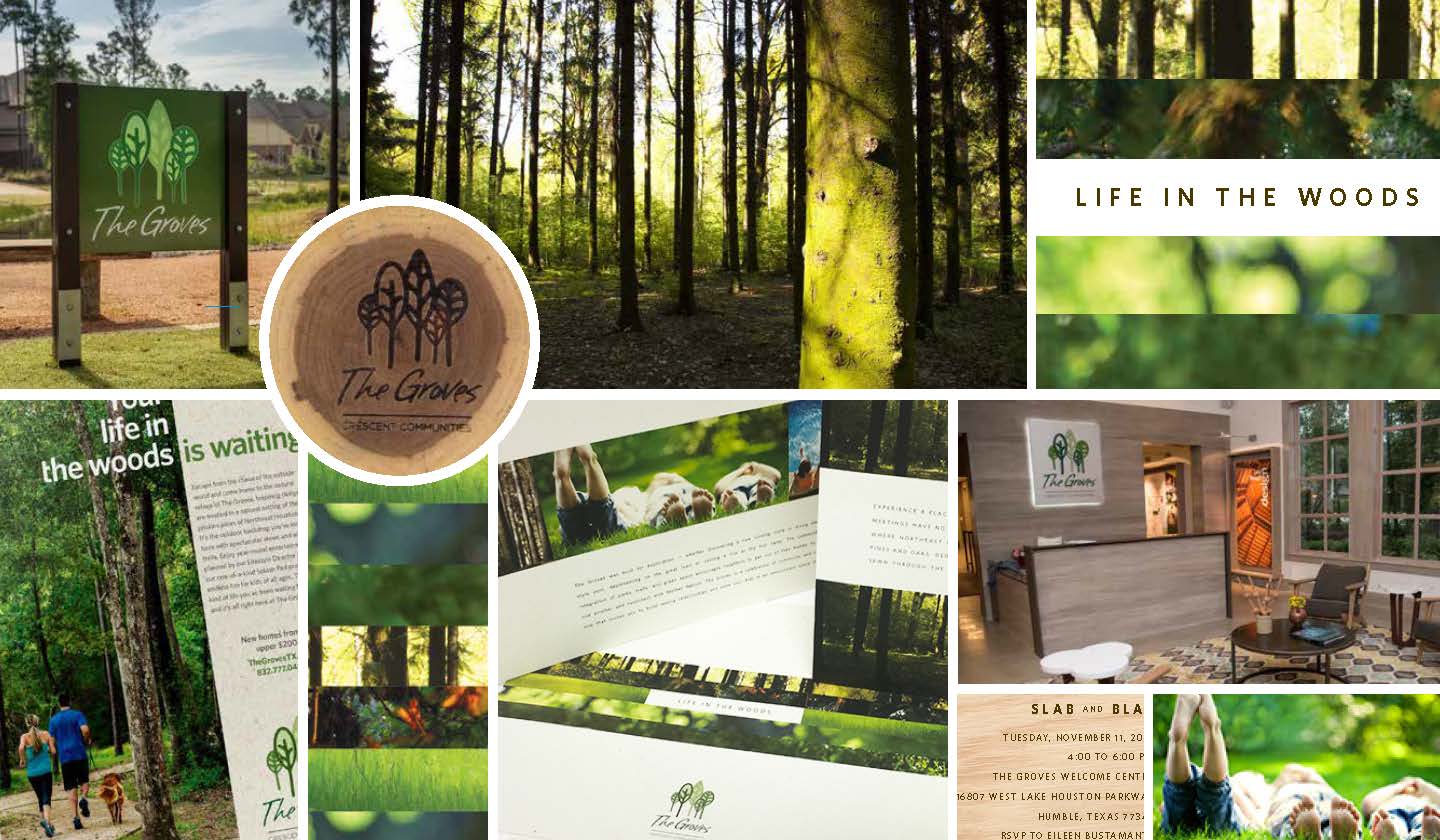
When The Groves was proposed in Houston, neighbors worried the development would erase the forest they valued.
The developer chose to preserve the forest and make it central to the community. Point named the development after the feature that could have been cleared and positioned it around “Life in the Woods.”
We worked with the planning team to identify which trees could remain. Trees that had to be removed were repurposed in materials used to promote the community, allowing the land to remain part of the story even where construction required change.
The forest carried through the identity, sales experience, launch events, and ongoing programming. Prospective buyers didn’t encounter a generic development with a wooded amenity tucked into the back of the plan. They encountered a community built around a clear idea.
The campaign generated 90% presales and earned multiple national homebuilding awards.
The trees alone didn’t produce that result. The result came from aligning the land plan, positioning, design, marketing, and resident experience around an authentic feature competitors couldn’t duplicate.
Activate the Land Before the First Family Arrives
The strongest developers are extending that principle beyond branding.
At Landmark in Denton, Hillwood Communities incorporated a preserved section of the Cross Timbers Forest into a plan that includes approximately 1,100 acres of parks, trails, and wild spaces. Hillwood hired a certified Texas Master Naturalist as the community’s director of Wellness in Nature. Her programming includes guided hikes, wildlife education, fishing events, outdoor fitness, and children’s activities.
The role began taking shape before the first home was built.
At Ramble in Celina, Hillwood planned homes and amenities around mature trees, rolling hills, lakes, and more than 200 acres of preserved open space. The community’s trail network and outdoor programming turn those natural features into something residents can experience rather than simply view.
That distinction matters. Open space becomes more valuable when buyers understand how it will fit into their lives.
Measure What the Land Produces
Once the plan is set, track whether the natural features deliver the expected value.
Compare:
- Price and margin on lots near preserved land
- Sales pace by lot location
- Model-home traffic generated by nature-focused campaigns
- Lead-to-tour and tour-to-sale conversion rates
- Performance of creative featuring natural amenities
- Earned-media coverage and community sentiment
- Participation in outdoor programming
- Referral and resident-satisfaction rates
- Results against comparable phases or communities without the same features
Use the findings in future phases and land plans. If creek-adjacent lots sell faster, quantify it. If buyers respond to trails but not generic sustainability language, adjust the messaging. If a particular natural feature supports both a premium and a faster pace, protect it early in the next plan.
That discipline is especially important in a difficult housing market. RCLCO reported that sales among the 50 top-selling master-planned communities rose approximately 2.9% during the first half of 2026, even as national new-home sales fell 5.6% year over year in June.
Lifestyle, amenities, housing variety, and a strong sense of place can help master-planned communities outperform a weaker market. Preserved nature can contribute to all four, but only when developers plan, market, and measure it deliberately.
Put the Trees on Both Sides of the Ledger
Developers shouldn’t save every tree. Some are unhealthy, badly placed, or incompatible with the infrastructure and density a project requires.
But they also shouldn’t assume every preserved acre represents nothing more than lost lots.
Trees and green space can influence buyer preference, price, absorption, entitlement risk, community support, and the strength of a real estate development marketing strategy. Those effects deserve a line in the model before clearing begins.
Count the lots. Then count everything the land can produce.